

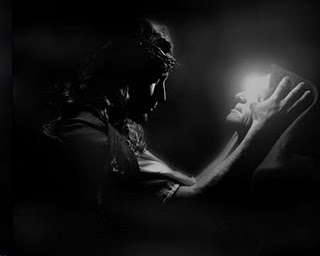
 Today’s Gospel reading at Mass cites a unique incident from Jesus’ career: a two-stage healing.
When Jesus and his disciples arrived at Bethsaida, people brought to him a blind man and begged Jesus to touch him. He took the blind man by the hand and led him outside the village. Putting spittle on his eyes he laid his hands on the man and asked, “Do you see anything?” Looking up the man replied, “I see people looking like trees and walking.” Then he laid hands on the man’s eyes a second time and he saw clearly; his sight was restored and he could see everything distinctly. Then he sent him home and said, “Do not even go into the village” (Mark 8:22-26).
There are two things we can learn from this:
1. This is more historical proof of Jesus as a wonderworker. No Christian is going to make up an account about Jesus’ healing not quite “working” the first time, especially when so many of Jesus’ miraculous deeds (healings, exorcisms, nature miracles) happen instantaneously, at his word, even from a distance. This smacks of authenticity and eyewitness detail. Furthermore, this is more evidence that the evangelists didn’t feel free to “invent” incidents from the life of Christ, or feel free to “edit” accounts of Jesus’ life that were passed on by tradents and collected into the Gospels. If that were the case, this account would have almost certainly been “cleaned up” by the evangelist, with the healing working at once.
2. This is a “sacramental” healing. Jesus didn’t need to take spittle and use that to heal the man’s vision. But the fact that he did shows that God can use matter to communicate his grace – that is, his very life. This should be obvious when considering the Incarnation itself. The body of Christ communicated, and was the very vehicle, of the life of God on earth. And Christ continues to communicate his healing powers through the sacraments of the Catholic Church. The sacraments each take ordinary, physical materials – water, bread, wine, oil – and, in the case of marriage, the very bodies of the spouses themselves – to communicate the life-giving power of God. The Eucharist, of course, is the greatest of all sacraments, because, as Saint Thomas aquinas once said, in all the other sacraments, the power of Christ is present; in the Eucharist, Christ himself is present – Body, Blood, Soul, and Divinity.
The sacraments of the Church bring the power to see life and eternity – all of reality – in ever clearer and sharper focus. Like the blind man, we don’t always see this clearly at first, even after receiving the sacraments. We have to go “outside the village” and never go back in, like Christ led out the blind man – we must leave our old ways behind. And, as Saint Jerome taught, the “spittle” of Christ, which represents his word, his teaching, must be applied to our lives – that is, obeyed – for the healing of our lives to be complete.



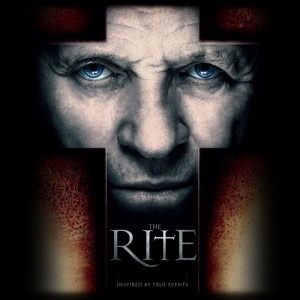 The new movie, The Rite, #1 at the North American box office this past weekend, once again reveals Hollywood’s fascination with exorcism. 1973’s The Exorcist began this trend in earnest, with 2005’s The Exorcism of Emily Rose a more recent example. All three movies are at least in part based on actual cases.
 On a day when U.S. President Barack Obama gave the “State of the Union” address, it’s apropos that today is the feast marking the conversion of Saint Paul. This, in turn, denotes the close of the Week of Prayer for Christian Unity. And without true conversion, Christian unity will always be relegated to fantasy status. It seems that many Christians have either a) given up on the concept completely, or b) have a skewed vision of what true Christian unity looks like.
 A friend who is a spiritual seeker recently asked, “Why are there so few non-religious documents to support the existence of Jesus?”
 Now you can download version 1.1 of The New Mass app from the iTunes App Store! For those of you who already have The New Mass, simply download the update from the App Store on your iOS device. Click