
Here’s my December article for Catholic Answers Magazine. Merry Christmas!
“The beginning of the gospel of Jesus Christ, the Son of God” (Mark 1:1).
The Gospel of Mark doesn’t have an “infancy narrative” about the events surrounding Jesus’ conception and birth as do Matthew and Luke. Rather, Mark begins in a deceptively simple manner with these opening words, known as an incipit.
Almost 2,000 years after these words were originally inscribed on parchment, we tend to read this line and think nothing much of it—perhaps even yawn—because it’s something we’ve heard many times before. And yet with this simple sentence, Mark would have absolutely shocked the entire world, arresting the attention of pious Jews and pagan Romans alike.
With respect to a Jewish audience, it’s easy to see why: in calling Jesus the Christ, Mark signals that he the long-awaited Jewish Messiah. But it’s the term Son of God that would have raised many a Roman eyebrow (remember—Mark’s Gospel was written to the Church at Rome, where he served as the chronicler of Peter’s memoirs of the Lord). Why is that?
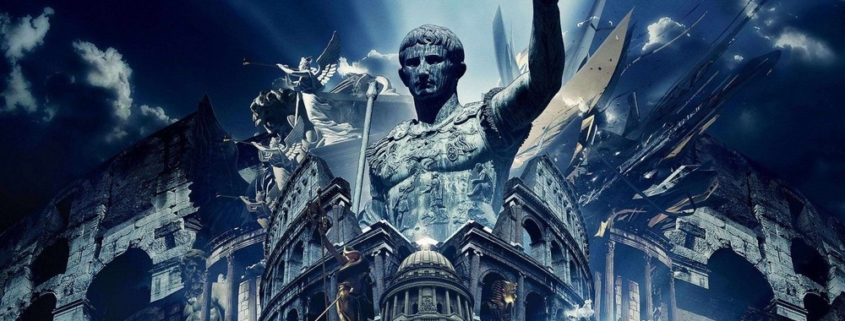
Mark has a big problem as he tries to convince Romans that they should commit their lives to Jesus—and the crux of the matter is the cross itself. Who was the most powerful person in the Roman Empire? Why, the emperor himself, obviously. The Roman Caesars were crowned in an elaborate ceremony in which they were draped in a royal purple robe, with great pomp, amidst shouts of “Hail, Caesar!” When a new emperor ascended to the throne, or when Rome scored a great military victory, it was published throughout the empire as “Good News.”
In contrast, the most powerless person in the empire was the victim of crucifixion. This was an ordeal so brutal, so violent, so humiliating, that it was almost never administered to Rome’s own citizens (for whom the comparatively humane act of beheading was the preferred method of execution, as in St. Paul’s case). The contrast between the mighty Caesar and the seemingly defeated Jesus couldn’t have been more stark. This is why one major commentator on Mark calls that Gospel an “apology for the cross.”
We could add to this the many public inscriptions that have been unearthed from Rome’s ruins. These served as a civic catechism of sorts, proclaiming what one was supposed to know and believe as a citizen. And one thing all Romans were expected to assent to was this: not only was the emperor extremely powerful, he was to be considered the divine “son of god.” Here are just a few examples from a much longer list compiled by Craig Evans:
- Julius Caesar (48-44 B.C.):
An inscription from Ephesus describes him as “the manifest god from Ares and Aphrodite, and universal savior of human life.” Also, from Carthaea: “The Carthaean people honor the god and emperor and savior of the inhabited world, Gaius Julius Caesar, son of Gaius Caesar” (there are many more such inscriptions from the period).
- Augustus (30 B.C.-A.D. 14):
“Emperor Caesar Augustus, son of god”; “Emperor Caesar (Augustus), god from god”; “Emperor Caesar Augustus, savior and benefactor.” An inscription from Priene celebrates Augustus’s birthday as “the birthday of the god.”
- Tiberius (A.D. 14-37, who reigned when Jesus was crucified):
“Emperor Tiberius Caesar Augustus, son of god”; and “Emperor Tiberius Caesar, new Augustus, son of god, Zeus the liberator”.
- Nero (the crazed emperor who reigned from A.D. 54-68—there are some real doozies here):
“Nero Caesar, the lord”; “Nero Claudius Caesar… the savior and benefactor of the inhabited world”; “The good god of the inhabited world, the beginning and existence of all good things”; “the son of the greatest of the gods”; and “Nero, the lord of the whole world”.
So, in light of this exalted view of their emperor, why should citizens of Rome choose to pledge their allegiance to Jesus and not Caesar? Readers or hearers of Mark would no doubt be asking this question as they experienced this Gospel. Well, its account of Jesus’ authoritative teaching about the Kingdom, backed up with powerful exorcisms and healings, would no doubt have made an impression.
But so too would the presence in Mark’s Passion narrative of someone whom we might easily overlook: the figure of the Roman centurion who sees Jesus die.
The centurion, whose ultimate superior is Caesar, the alleged “son of god,” may have been aware of how his fellows had humiliated Jesus in a mock “coronation” replete with purple robe and a crown of thorns, and shouts not of “Hail Caesar” but, “Hail, King of the Jews!” as they beat him mercilessly (Mark 15:16-20). Yet somehow, as he watches Jesus die on the throne of the cross, and witnesses the powerful release of Jesus’ spirit, which tears the temple curtain in two, the centurion is granted the grace to recognize that one far greater than Caesar is here: “Surely this man” — and not Caesar — “is the Son of God” (15:37-39).
This was the very statement—politically perilous and subversive—that Roman Christians had to make their own. A statement about who truly possessed a sovereign claim over the world. Many of them were to stare down the absolute claims and power of the state and pay for it with their lives, as Jesus did. Peter himself, the source behind Mark’s Gospel, would also meet the horrific cross.
As we prepare to celebrate the true “birthday of the God” this Christmas, let us reflect on the kingship Jesus claims over our lives. Having conquered the grave, a foe no earthly ruler, however exalted, has ever defeated, he is worthy of it.


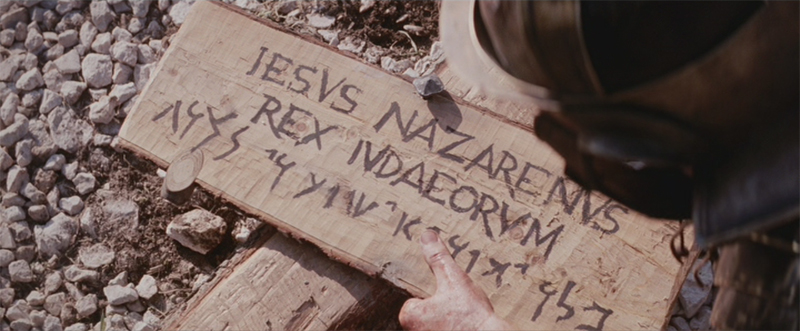 This Sunday, we celebrate the Solemnity of Jesus Christ, King of the Universe. This Sunday also marks the end of the liturgical year. In today’s Gospel (Luke 23:35-43), we read about the crucifixion of Jesus. Speaking of Jesus’ kingship, Luke here mentions the titulus (Latin for “title”, referring here to the the inscription above Jesus’ cross) that read, “This is the King of the Jews”.