

Cale refutes the implausible theory that the real reason Jesus’ tomb was empty was that his disciples stole his body.
Posts
Cale shows how the hallucination theory does not explain the Resurrection of Jesus.
Cale shows how the claim that the appearances of the risen Jesus were mere legends doesn’t hold water.
Cale discusses the physicality of Easter: this was NOT a symbol, but a real, bodily resurrection.
What made the great persecutor of the Christian faith its greatest propagator? The best explanation is that the resurrected and glorified Jesus appeared to Saul the Pharisee, who became better known as the Apostle Paul.
In this 2nd video from the Easter Evidence series, Cale looks at another piece of the argument for Jesus’ Resurrection: the testimony of women. The fact that all four Gospels present women as the first to encounter the empty tomb and the risen Lord is a major motive of credibility for the Gospels. Why? Because, unfortunately, women were considered extremely unreliable witnesses in the first-century Jewish world.
Happy Easter! Christ is Risen!
Hope you enjoy this video we recently filmed on our recent Faith Explained Pilgrimage to the Holy Land. At the most important Church in the world, the Church of the Holy Sepulchre, we briefly consider some of the compelling evidence for Jesus’ Resurrection.
Interested in joining us for our next pilgrimage? Reach out at TheFaithExplained.com/contact, and we will keep you updated with all the latest info on our upcoming tours!
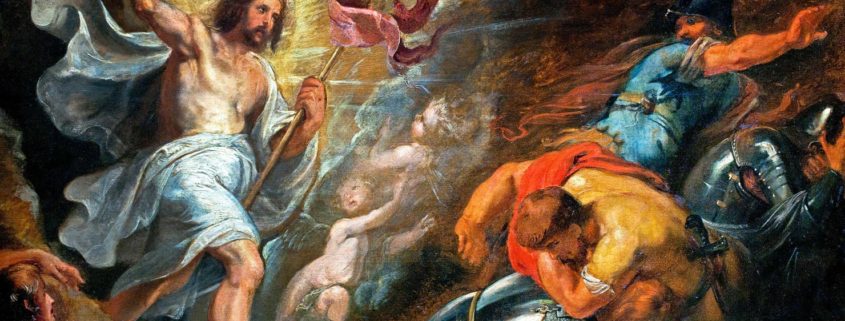
Here’s my latest piece for Catholic Answers. Hope you enjoy it. — Cale
Every Easter season we encounter articles, documentaries, books, and news reports suggesting that the canonical Gospels got the Resurrection wrong. Scholars with impressive credentials appear in the media to tell us that, if we want the full story about Easter, we must turn to what are known as the apocryphal Gospels.
It often comes as a surprise to Christians to learn that there were many other “Gospels” that circulated in the decades and centuries after the composition of Matthew, Mark, Luke, and John, but never made it into the New Testament. Some of these have survived to our day, to the fascination of scholar and layman alike. But do these works indeed provide credible information about Jesus that isn’t in the Bible?
A professor of mine always gave this advice to students who were curious about these writings: “Just read them,” he said, “and ask yourself this question: do you really think they smack of authenticity?” Some of the scholars who champion the apocryphal Gospels imply that the Church hid these documents from the people because they contain the “real” story about Jesus. But reading them, as Dr. Evans knew, shows that the Church had very good reasons for not canonizing these works. Far from radiating authenticity, they come across as quite strange and not reliable historically.
Let’s take one example of these texts, the Gospel of Peter, and compare its Easter narrative to that in the Gospel of Matthew.
Matthew’s account of the Resurrection, written in the first century, is sober and rather restrained—especially compared with the account in the Gospel of Peter, a highly embellished collection of legends likely written in the second century. (No, it wasn’t actually written by Peter, don’t worry—later writers would attribute their works to apostles in an attempt to gain credibility).
Far from being an early, original source of material on the life of Jesus, the Gospel of Peter is actually dependent on the canonical Gospel of Matthew for much of its content. Its unbelievable reworking of the Resurrection account in Matthew includes—get this—a talking cross that emerges from Jesus’ tomb along with the risen Jesus and two angels, all of whom are so tall that their heads are, quite literally, in the clouds (39-43). It also mentions many other elements that a Jewish audience would find implausible and ahistorical, such as members of the Jerusalem religious elite pitching tents and sleeping among the tombs with Roman soldiers, making sure Jesus stays dead (33, 38). Ever heard of uncleanness and ritual impurity? Hello!
The Gospel of Peter therefore lacks what is called verisimilitude. Its miraculous details seem purposely fantastic. It doesn’t cohere with the way things actually were in Jesus’ time and place. Readers of Matthew’s Easter account, especially those of a Jewish background, would have found its Easter account much more credible and persuasive. Let’s look at some of its details.
Facets of Matthew’s account of Jesus’ burial later become important proofs for Jesus’ resurrection. The mention of Joseph of Arimathea’s donation of a new tomb for Jesus burial (Matt. 27:57-61) is significant. Joseph, who is mentioned in all four Gospels and undoubtedly a historical personage, was a member of the Sanhedrin, and thus a known public figure. This means that the location of Jesus’ tomb was also known to friend and foe alike. If Jesus’ remains were still entombed following Easter, it would have been easy to prove this by searching Joseph’s tomb. However, even the enemies of the nascent Christian movement do not dispute the empty tomb (Matt. 28:11-15). Matthew also notes that many of Jesus’ women followers saw the place where Jesus was buried (27:56; 27:61; 28:1-8), discrediting any theory that the women went to the wrong tomb on Sunday morning.
Among the canonical Gospels, only Matthew’s mentions the presence of Roman guards at the tomb, a point that many critics of the Gospel dispute. The Gospel of Peter also mentions the guards, though again with legendary accretions. Even so, this demonstrates that the guard account was an enduring aspect of the apologetic for the Resurrection. Therefore it is more certain, from a historical perspective, that guards were in fact present.
The chief priests, after hearing “everything that had happened” from the guards, bribed the soldiers to propagate the story that the disciples of Jesus stole his body from the tomb while they slept (a first-century edition of “fake news,” one might say). Matthew reports that, at the time of the writing of his Gospel, this version of events was still being told among the Jews (Matt. 28:11-15). In fact, this story became a well-entrenched facet of an anti-Christian Jewish apologetic, for Justin Martyr, writing in the second century A.D.,states that it was still being circulated in his time.
The guards’ probable historicity is even further bolstered by the edict of Caesar, possibly enacted in Galilee in the first century, decreeing capital punishment for grave robbers. The fact that tampering with Jesus’ tomb would have been punishable by both Jewish and Roman authorities, and that the tomb, according to Matthew, was sealed (Matt. 27:66), make any potential moving of Jesus’ body from the tomb highly unlikely in this case.
Add to that the fact that liars usually make terrible martyrs (why would the disciples later die for their belief in the Resurrection, if they had in fact stolen the body?), and one has a very solid case for the empty tomb. Again, even the enemies of the Christian movement admit the tomb is empty, and enemy attestation is excellent evidence.
But, of course, an empty tomb alone does not a resurrection make. This is why Matthew’s accounts of the appearances of the risen Jesus are so important. That Mary Magdalene and the other women “took hold of his feet” (Matt. 28:9) affirms the corporeal (bodily) nature of Jesus’ resurrection, making the same point as Luke 24:36-43 and John 20:24-29.
Matthew’s very mention of women as the first to discover the empty tomb on Sunday morning, encounter the resurrected Jesus, and inform the male disciples of the event is, in all likelihood, historical. Given the (unfortunately) very biased and low view of the testimony of women in both Jewish and Greco-Roman settings of the time, Matthew (and the other Gospel writers) would never have mentioned this unless it was factual. Consider these quotes from Jewish sources of the general period:
Sooner let the words of the Law be burnt than delivered to women (Talmud, Sotah 19a).
But let not the testimony of women be admitted, on account of the levity and boldness of their sex…since it is probable that they may not speak truth, either out of hope of gain, or fear of punishment (Josephus, Antiquities 4.8.15).
Any evidence which a woman (gives) is not valid (to offer)…This is equivalent to saying that one who is rabbinically accounted a robber is qualified to give the same evidence as a woman (Talmud, Rosh Hashannah 1.8).
The bizarre Gospel of Peter instead describes many prominent maleenemies of Jesus as witnesses to his resurrection. What a stark contrast to Matthew, who not only presents women as the first eyewitnesses of the risen Christ, but does not claim that anyonewitnessed the resurrection event itself. This striking omission, perhaps above all the other differences, testifies to the sober realism of Matthew and the other Gospels over the fantasies of apocryphal texts.
Q. This Easter season, how can I convince my friends that Jesus physically rose from the dead? It’s been especially difficult for me to do this because my friends are either a) not Christians, or b) they don’t believe the Bible is the Word of God. They simply think it’s a merely human book that contains things Christians believe.
A. The good news is that it is possible to show your friends plausible evidence that Jesus rose bodily from the dead. And you can do this without even appealing to the authority of the Church, or to the Bible as the Word of God. It’s called the “Minimal Facts” approach, popularized by Dr. Gary Habermas. There are five historical facts concerning the Resurrection of Jesus that must be accounted for, no matter what one believes. They are:
1. Jesus died by crucifixion. This is an event of history that is recorded outside the Bible. Many non-Christian historians, such as Josephus and Tacitus, wrote about it.
2. The tomb of Jesus was empty on Easter Sunday. All parties, both Christians and the enemies of Christ, agree that Jesus’ tomb was found empty on Easter Sunday. The fact that opponents of the Christian message admit this gives us the very best type of evidence for our case, called “enemy attestation”.
3. Jesus’ disciples were willing to suffer and die for their belief in the Resurrection. While many people are willing to die for what they believe is true, no one willingly dies for what they know to be a lie. The Apostles knew whether or not they had encountered the Risen Jesus in the flesh.
4. The Church persecutor known as Saul the Pharisee converted to the Catholic Christian faith, became Paul the Apostle, and was martyred for his faith in the Risen Jesus. This is an unimpeachable historical fact.
5. The skeptic James, a relative of Jesus, converted because the Risen Jesus appeared to him. James became the Bishop of Jerusalem and a martyr.
There are many more facts that we could mention, such as the evidence of the appearances of the Risen Jesus in his physical body to various individuals and groups , including 500 people at one time. This shatters the erroneous theory that Jesus’ disciples were ‘hallucinating” when they thought they saw Jesus. Hallucinations are individual occurrences and cannot be shared. Plus, they do not account for the empty tomb.
Whatever explanation one comes up with to attempt to explain our “minimal facts” listed above, one’s explanation must account for all of these facts, and must do so more persuasively than alternative arguments. The only explanation that accounts for all of these facts in such a manner is the conclusion that Jesus was Resurrected.
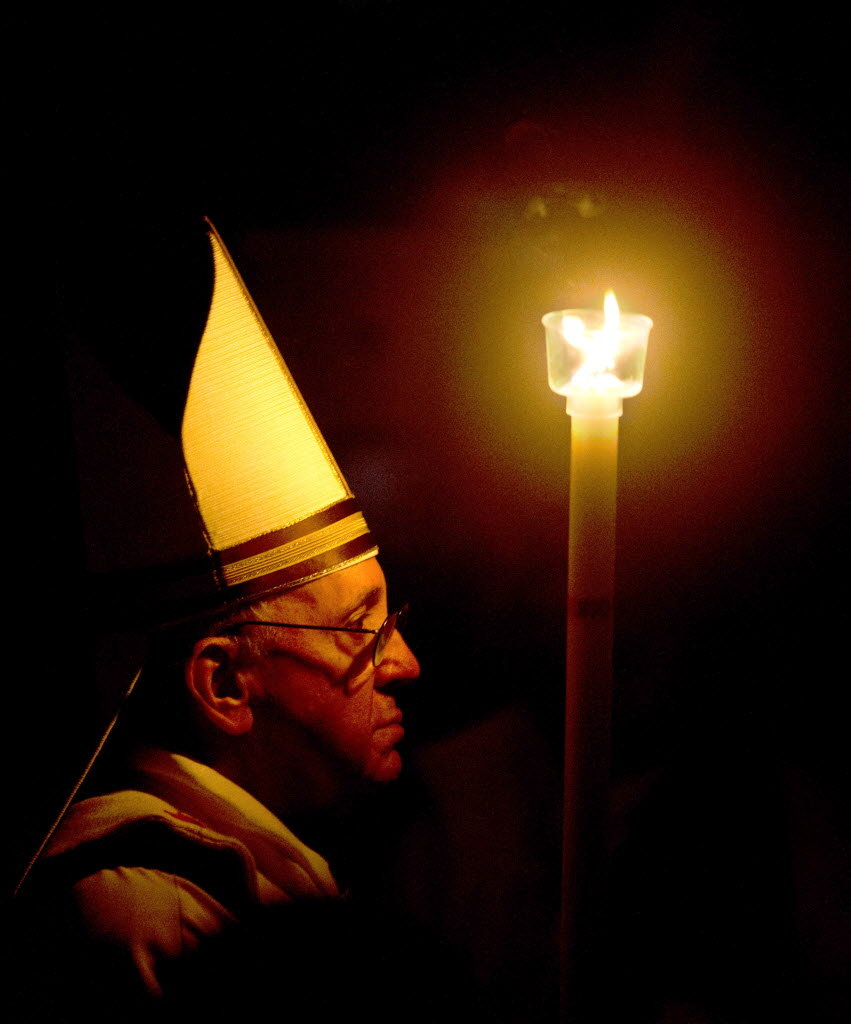
Here is the English translation of Pope Francis’ homily from tonight’s Easter vigil in St Peter’s Basilica, Rome. Happy Easter, everyone! Christ is risen! Alleluia!
Tonight is a night of vigil. The Lord is not sleeping; the Watchman is watching over his people (cf. Ps 121:4), to bring them out of slavery and to open before them the way to freedom.
The Lord is keeping watch and, by the power of his love, he is bringing his people through the Red Sea. He is also bringing Jesus through the abyss of death and the netherworld.
This was a night of vigil for the disciples of Jesus, a night of sadness and fear. The men remained locked in the Upper Room. Yet, the women went to the tomb at dawn on Sunday to anoint Jesus’ body. Their hearts were overwhelmed and they were asking themselves: “How will we enter? Who will roll back the stone of the tomb?…” But here was the first sign of the great event: the large stone was already rolled back and the tomb was open!
“Entering the tomb, they saw a young man sitting on the right side, dressed in a white robe…” (Mk 16:5). The women were the first to see this great sign, the empty tomb; and they were the first to enter…
“Entering the tomb”. It is good for us, on this Vigil night, to reflect on the experience of the women, which also speaks to us. For that is why we are here: to enter, to enter into the Mystery which God has accomplished with his vigil of love.
We cannot live Easter without entering into the mystery. It is not something intellectual, something we only know or read about… It is more, much more!
“To enter into the mystery” means the ability to wonder, to contemplate; the ability to listen to the silence and to hear the tiny whisper amid great silence by which God speaks to us (cf 1 Kings 19:12).
To enter into the mystery demands that we not be afraid of reality: that we not be locked into ourselves, that we not flee from what we fail to understand, that we not close our eyes to problems or deny them, that we not dismiss our questions…
To enter into the mystery means going beyond our own comfort zone, beyond the laziness and indifference which hold us back, and going out in search of truth, beauty and love. It is seeking a deeper meaning, an answer, and not an easy one, to the questions which challenge our faith, our fidelity and our very existence.
To enter into the mystery, we need humility, the lowliness to abase ourselves, to come down from the pedestal of our “I” which is so proud, of our presumption; the humility not to take ourselves so seriously, recognizing who we really are: creatures with strengths and weaknesses, sinners in need of forgiveness. To enter into the mystery we need the lowliness that is powerlessness, the renunciation of our idols… in a word, we need to adore. Without adoration, we cannot enter into the mystery.
The women who were Jesus’ disciples teach us all of this. They kept watch that night, together with Mary. And she, the Virgin Mother, helped them not to lose faith and hope. As a result, they did not remain prisoners of fear and sadness, but at the first light of dawn they went out carrying their ointments, their hearts anointed with love. They went forth and found the tomb open. And they went in. They had kept watch, they went forth and they entered into the Mystery. May we learn from them to keep watch with God and with Mary our Mother, so that we too may enter into the Mystery which leads from death to life.